ABOUT
FEEDSCONTACT
EMAIL DIGESTCANDY RATINGSTYPE
BRAND
COUNTRY
ARCHIVES
|
Wednesday, May 14, 2014
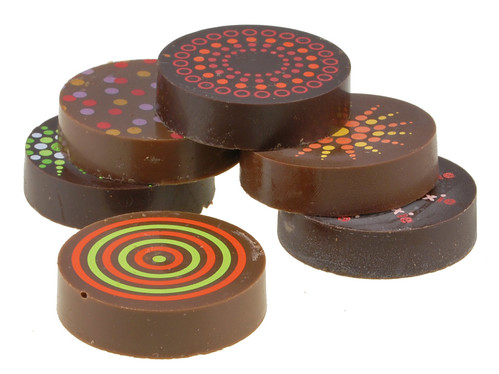
Eat with your Eyes: Truffle Disks
There was a time, a few years back, when Target used to have its own brand of chocolate called Choxie. They used a variety of companies to create their custom branded confections, so it turned out a little uneven. Some of it was good, some of it wasn’t quite as well made. I miss the adventure of such a large new product line, but I think Target does a much better job of curating top brands than creating something from scratch like a whole line of chocolate products. POSTED BY Cybele AT 7:23 am Candy • Choxie (Target) • Highlight • Photography • Tuesday, May 13, 2014
Candy Tease - Sweets & Snacks Part 1Next week is the annual Candy and Snack Expo in Chicago. It’s the even of the year for candy companies, as they introduce their new products. Here are a few new items that caught my eye with some already hitting shelves. There’s lots more in store, so I’ll be posting a few over the next two weeks.
All images courtesy of the respective manufacturer POSTED BY Cybele AT 8:44 am All Candy Expo • Candy • New Product Announcement • Highlight • Featured News • Wednesday, May 7, 2014
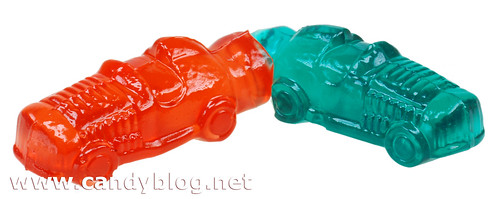
Eat with your Eyes: Monopoly Gummi Cars
The New York Times had an interesting story about the resurgence of board games. Maybe folks should swap out their Monopoly pieces with gummis, though. POSTED BY Cybele AT 12:47 pm Candy • Highlight • Photography • Monday, May 5, 2014
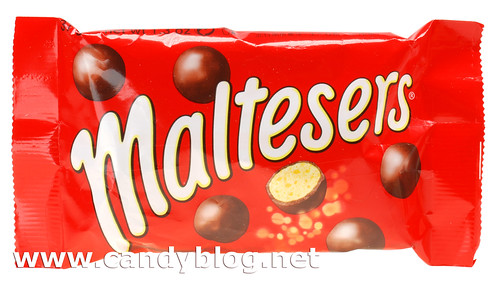
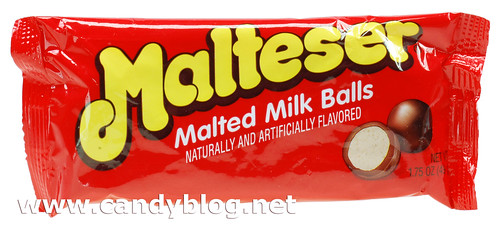
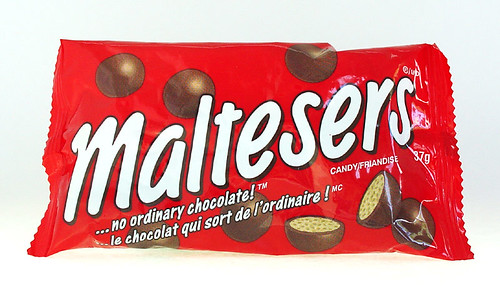
Mars challenges Hershey’s over the use of the name Malteser in USIn the battle for marketshare in the confectionery sector, it seems that some candy companies are more interested in getting our business by eliminating competition than gaining brand loyalty with exemplary products.
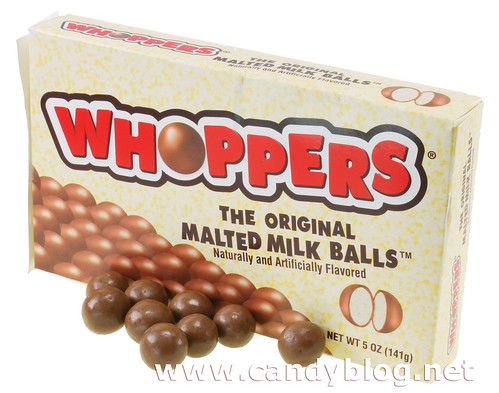
The latest battle involves old rivals Hershey and Mars, this time over malted milk balls. Mars makes Maltesers and Hershey’s makes Whoppers. But Hershey’s is also trying to assert the exclusive right to also make something called Malteser in the United States. I don’t have the figures, but I’m going to guess that Hershey’s holds more than 70% of the market in malted milk balls with their Whoppers brand, but not necessarily because they’re the best but because they’re ubiquitous. Though I don’t have current figures, I’d estimate the brand is worth about $40 to $50 million in sales a year.
Here’s a little history. Mars Maltesers were first sold in the United Kingdom in 1937. They were created as a diet candy; a chocolate candy with less chocolate and therefore less fat and calories. They’re also sold in Canada, New Zealand and Australia and exported to many other European countries. They can be purchased in shops that specialize in UK imports. Based on the number of brand extensions I’ve seen for Maltesers on my recent trip to London, I’d say that the candy is a much more important brand to Mars than Whoppers are to Hershey’s. Which may make them appear a threat.
In 1939 an American candy company called Overland, introduced a malted milk ball candy sold under the name Giants, as they were larger than earlier versions called Malt-ettes. In 1949, two years after the company was sold to Leaf Inc, they were renamed Whoppers. There were many other companies that came and went that sold malted milk balls, but Whoppers have been made continuously ever since, even if their corporate overlords have changed. Leaf Inc was once a formidable sugar candy company, the fourth largest in the US. They acquired many favorite American candy brands, including Jolly Rancher, Hollywood Brands (maker of Payday bars), Heath Bar, and Now and Later. Sometime in the 1960s Leaf started making something called Malteser and even registered a trademark for the name in 1962. I doubt they were widely distributed or advertised, as I can’t find any record of them . In 1983 Leaf was bought out by Huhtamäki Oyj, a Finnish company, which maintained the trademark registration. Mars sued Leaf over this trademark in 1993 and later settled out of court (so we don’t know the details) but Leaf retained the trademark. For reasons I don’t quite understand, Leaf Inc divested and sold off many of its best brands, most to Hershey’s: Whoppers, Payday, Jolly Rancher and Heath Bar.
The way trademarks work, not only do you need to register the trademark in all territories you plan to exercise it, you also need to use it. So if Hershey’s wanted to keep Mars from using Malteser in the US, by claiming it was an abandoned trademark, they had to demonstrate that Hershey’s wasn’t using it. I was able to find Hershey’s Malteser for sale on both the Hershey’s site and Amazon. I bought a box to confirm that they are just Whoppers in a different package. (They are.)
Mars contends that not only is Hershey’s squatting on the trademark in the United States, but that their packaging is intentionally confusing consumers to think that they’re purchasing the Mars version. I admit, they do look similar and even though I’m the candy blogger, I couldn’t remember of the top of my head if the Mars version was plural or singular until I started this research. American trademark law is governed for the most part under the Lanham Act which covers trademark infringement and false advertising. The act was also revised in 1999 to encompass cybersquatting, the practice of registering domain names and then sitting on them or directing them to a competitor. While Hershey’s practices up to the point where they created similar packaging were probably within the letter, though not the spirit of the law, my opinion after looking at the history, reading Mars’ brief on the case leads me to conclude that Hershey’s is just acting scummy. Whoppers are known by 300 million people in this country ... and if it’s not a favorable brand then Hershey’s should improve their quality, price point or packaging to the point where people are loyal to them.
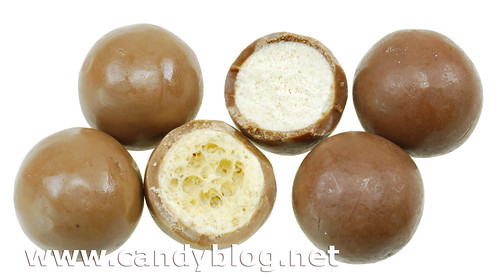
I tried both again, just to check. Neither is great, but the do differ. Both have a mockolate coating, though the Mars version does have some cocoa butter in there. The centers, though both malty, have different textures. The Mars version is more honeycombed and has a easier crunch. The Hershey’s version is more milky tasting with a firm crunch that dissolves nicely. Both are excellent centers ... both have disappointing coatings. I prefer the Mars Maltesers.
I’m a extremely curious if Mars were to introduced Maltesers in the United States if they would change the coating to real chocolate, as they do not make any mockolate products for the American market. However, Mars does not have a good track record for introducing the European candies to the US when there is another similar candy already on the market. They tried this with the Bounty bars, which are similar to Mounds and Almond Joy and they never took hold. Twix was a European launch that was then introduced in the US, but is a unique candy construction, which is how it established itself in its niche. This is not an isolated issue in the candy business. Many candy companies go head to head in the courts instead of on the store shelves. - The UK the courts have been deciding whether Cadbury should have exclusive rights to their shade of purple. Currently, the answer is no. For more reading on the issue, here are some other trade articles on the case: Related Candies
POSTED BY Cybele AT 11:41 am Candy • Hershey's • Mars • Malt • Mockolate • United Kingdom • United States • Highlight • News • Friday, May 2, 2014
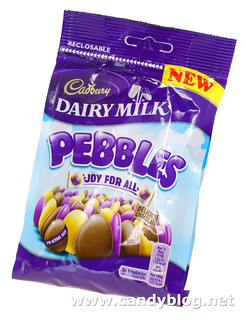
Cadbury Dairy Milk Pebbles
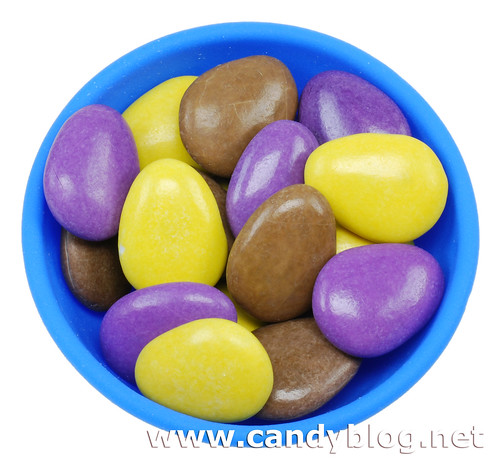
Now Cadbury has a shell candy for all year round consumption, completing their entry into the world of morselization. I’ve also seen that Cadbury’s parent company, Mondelez (once part of Kraft) has created bagged mixes that include the Pebbles, mini Oreos, and Maynard’s gummi candies. Kind of like the M&Ms Sweet & Salty Snack Mix that came out from Mars. Like most Cadbury chocolate products in the United Kingdom, this is not real milk chocolate. It’s what’s commonly called “family chocolate” which is a nice way of saying, “We don’t need to waste expensive cocoa butter on children, we’ll substitute some oil in there.” So it’s a quasi-mockolate product that uses some cocoa butter and some vegetable oil. Still, it’s not like it’s R. M. Palmer mockolate, it’s made from 23% milk content and 20% cocoa content ... then, you know, some sugar and a few oils, natural colors and shellac.
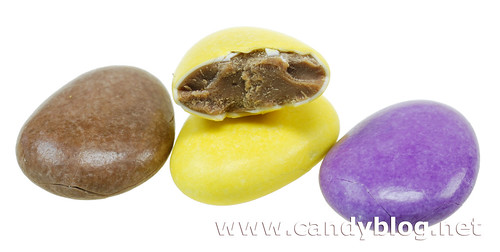
Instead of going with the typical lentil shape, the pieces are like flattened Cadbury Mini Eggs. They’re kind of like guitar picks. The colors are plain, for the most part when I dumped them out of the bag they were a little chalky looking but polished up pretty easily with a paper towel. (I figured they deserved a little spa treatment after being carted partway around the world.)
The yellow ones are a bit strange though, because of the all natural colorings, the ingredients on this particular one is a little odd. It’s kind of like curry ...a little grassy. The chocolate center is smooth, a little malty but with a thin punch of chocolate flavor. The shell is wonderfully crunchy, outside of the odd yellow one. The whole combination is really a great candy, I enjoyed eating them, though it certainly didn’t satisfy my desire for chocolate. I would be interested in trying these in some sort of mixed bag with mini Oreos and perhaps a few nuts. I doubt that Cadbury will attempt to license this to Hershey’s for production under their deal. So American’s will have to content themselves with imports or just stocking up in the Easter version. They contain milk, corn and soy. There’s no statement about nuts or gluten. Though Cadbury has started certifying some candies with sourcing information, the Dairy Milk Pebbles did not have a the Fair Trade or Rainforest Alliance stamp. Related Candies
POSTED BY Cybele AT 10:48 am Candy • Morselization • Review • Cadbury • Kraft/Mondelez • Chocolate • Mockolate • 7-Worth It • United Kingdom • 
|
Meticulously photographed and documented reviews of candy from around the world. And the occasional other sweet adventures. Open your mouth, expand your mind.
  SEARCHSearch the Candy Blog archives

    
FEATURED NEWS ITEMS
COPYRIGHT NOTICEAll content (text and photos unless otherwise credited) is copyright 2005-2026 by Cybele May Please do not use my photos without prior permission directly from me, they represent what I ate in preparation for these reviews and are not to be used for other purposes. Design by Hop Studios
|
||||||||||||||||||


 SUPERB
 YUMMY
YUMMY  TASTY
TASTY  WORTH IT
  TEMPTING
  PLEASANT
  BENIGN
  UNAPPEALING
  APPALLING
  INEDIBLE
 Name: PEEPS Minis
 Name: Ferrero Golden Gallery
 Name: Queen Anne Cherry Cola - Cordial Black Cherries
 Name: Brach’s Apple Pie Candy Corn
 Name: Wonka Randoms