ABOUT
FEEDSCONTACT
EMAIL DIGESTCANDY RATINGSTYPE
BRAND
COUNTRY
ARCHIVES
|
Wednesday, March 9, 2011
Kraft Daim
According to Wikipedia, the development tale is rather curious. Marabou, the preeminent Swedish chocolate company, approached Heath Bar back in the early 1950s for permission to license the Heath name and recipe to be produced for the Swedish/Norwegian marketplace. Heath said they couldn’t but did furnish the basic recipe so Marabou created the Daim Bar. The Daim went on to become quite a sensation, so much so that Hershey’s decided it needed its own crunchy toffee bar and copied the Daim in the US and called it Skor (along with the tag line of “The Taste of Sweden” in their launch advertising). The funniest part of the whole thing about Hershey’s marketing a copy of a Swedish candy that was a copy of an American candy was that Hershey’s ended up buying Heath Bar when they acquired Leaf Candy Company in 1996. Marabou, in turn, was bought out by Kraft back in 1993 which distributes the Marabou chocolate products around the world. The easiest place to find Daim bars is at IKEA.
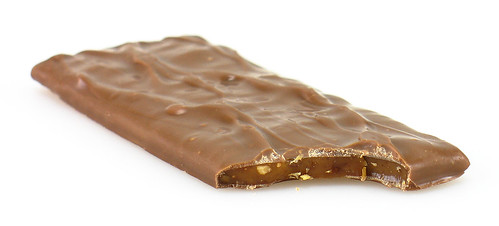
The bar does look a lot like the American Skor. It’s a smallish bar, flat and with a crisp buttery toffee center with a few bits of almonds in there. The milk chocolate coating is a little thicker on top with some attractive swirls and waves. At only 28 grams (about .99 ounces) it’s a small bar but provides a lot of crunch. I’ve bought this bar at least three different times for review on Candy Blog and each time I’ve managed to eat it before reviewing. (The photos here are from a 2008 episode where at least the bar made it into the studio for documentation.)
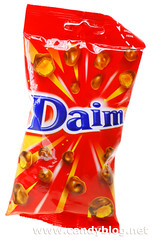
Since I knew I could find another bar in the States if I wanted it, I picked up this 100 gram (3.5 ounce) bag of Daim. The package says nothing else on the front - no description, no brand name ... just Daim. Not even the fact that this is not a bar but little chocolate covered nuggets. I guess the picture on the front says it all. My guess is since Daim is available in so many countries, it’s just confusing to say things, why not show them? The back of the package features micro-printing to accommodate at least 8 different language versions of the ingredients and still no actual name of the product. So I’m going to call these Daim Nuggets.
The little pieces are actually better, in my opinion, than the bar. I loved them. The chocolate is certainly not of excellent quality but good enough for this purpose. It’s milky and sweet and just creamy enough. It seals in the crunchy pieces of toffee to keep them from getting sticky and syrupy. The toffee has a light burnt taste to it, plenty of milk and a touch of salt. It’s crunchy and every once in a while I think I got a little bit of an almond. The toffee is cooked to perfection - it’s crunchy but not too hard (having small pieces helps) and also doesn’t get tacky or stick to my teeth in large clumps. I bet this is great on ice cream or added to cookies, of course it would need to come in larger bags, because this one is empty. Other Daim reviews: Chocablog, Jim’s Chocolate Mission and Candy Addict. Related Candies
Tuesday, March 8, 2011
Eat with your Eyes: Spheres
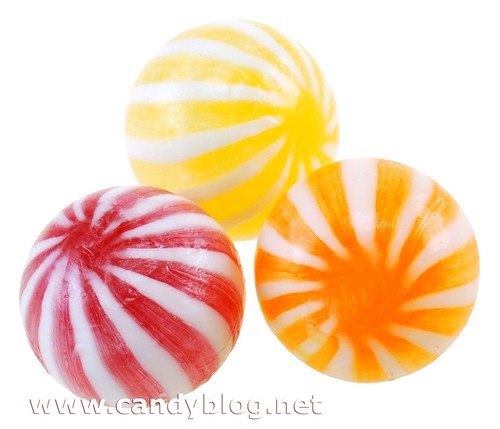
These are probably larger than you think they are, about the size of a shooter marble. I haven’t actually eaten them yet, I just liked the way they looked. (I don’t know who made them, just that I picked them up at the French Pavilion at ISM Cologne.) POSTED BY Cybele AT 7:23 am Candy • Highlight • Photography • Monday, March 7, 2011
Helliemae’s Salt CaramelsCaramels are best when they’re made fresh with only a few ingredients. There are decent caramel simulations found in commercial stores, but the true stuff cannot be readily imitated with the shelf life necessary for large scale business.
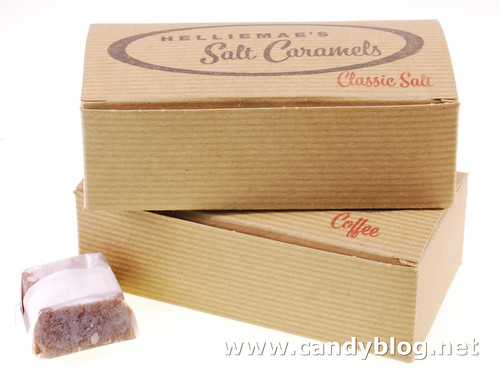
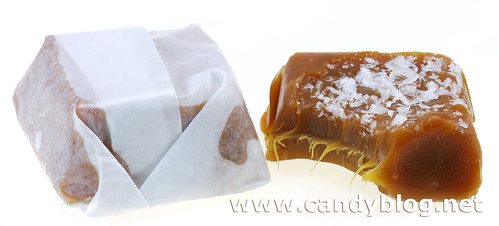
These small boxes from Helliemae’s Caramels contain a half a pound each; they’re like little sugar and dairy bricks. The caramels themselves are made from the classic ingredients and nothing else - sugar, butter, cream, vanilla and sea salt.
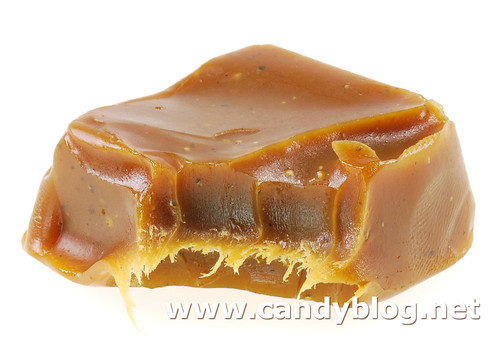
Each caramel is a large square, about 1.3 inches across and a little less than an inch high. They appear to be molded instead of cut, because they have slightly angled sides, like ice cubes. The Classic Salt Caramels have a generous dusting of flaky sea salt on top. When I first bit into them I was impressed by the smooth texture, firm chew that wasn’t too tough. They’re a bit sticky but when consumed with some hot tea or coffee that dissolves quickly. But the salt on top was too much for me. The caramel itself was perfectly salted to begin with ... a few grains up there would have done me fine, but it wasn’t a flurry, it was a blizzard with consistent accumulation. I’m a bit more sensitive to salt than many of my pals, so I handed some off and found the same comment - far too salty. So for the rest of them I found myself scraping the salt off as completely as possible or eating from the bottom and discarding the crusty tops. 7 out of 10
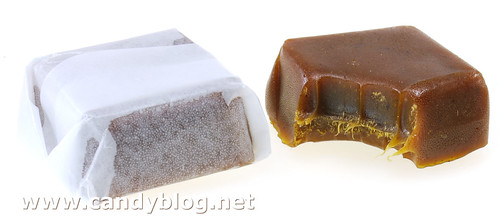
I was also given a single sample of the Cardamom Caramels. Cardamom is a hard spice to use, especially with a confection like caramel which tends to boil away the intensity of flavors. In this case the cardamom is added as a coarse powder of the seeds of the pod itself. The cardamom has flavor notes of pine, bergamot, lemon, vanilla, nutmeg, cola and eucalyptus. In some candies I’ve had the cardamom seeds can be intense and distracting though still imparting an amazing flavor that still manages to make up for it by being so engaging. In this case the grain was smaller than ground espresso so it was virtually unnoticeable. The flavor was citrusy and really brought out the vanilla and toffee notes. In this case there was no salt on top, so I was quite pleased. 9 out of 10
The final flavor I tried was another half pound sampling of the Coffee Caramels. These were pure perfection. The coffee flavors were intense but smooth, like a fine espresso with the perfect head of creama. They were bitter and had loads of toffee and roasted java notes but also an appealing tangy note of woodsy coffee that rounded it out. Since there was no salt on top, I found this to be exactly how I like my caramels. 9 out of 10 Fresh caramels need to be consumed immediately. I ate and shared the majority of these within two weeks of getting them, but the few that I saved for review did kind of lose their mojo after about three weeks - getting sticky and grainy around the edges. I liked that the format that was easy to bite and that the wax paper was easy to unwrap. A chocolate coated version might be stupendous, especially if it was a super dark that offset the sweetness and salt. They’re a bit expensive for me but for an impulse item if I lived in the area and saw one at the cash register at the store of a cafe, I would definitely go for one even at $3 a pop. Related Candies
POSTED BY Cybele AT 5:21 pm All Natural • Candy • Caramel • 7-Worth It • 9-Yummy • United States • Friday, March 4, 2011
Eat with your Eyes: Cows
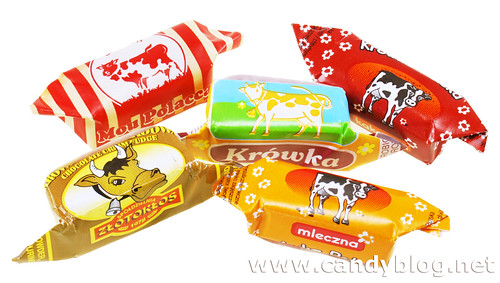
While I was sorting my candy from the ISM Cologne trade fair, I usually grouped products together in little baggies according to the manufacturer. At one point I found that I had a lot of little cream fudge pieces that had pictures of cows on them.
I reviewed this version of Polish Cream Fudge last summer. POSTED BY Cybele AT 11:51 am Candy • ISM Cologne • Highlight • Photography • Thursday, March 3, 2011
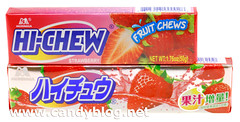
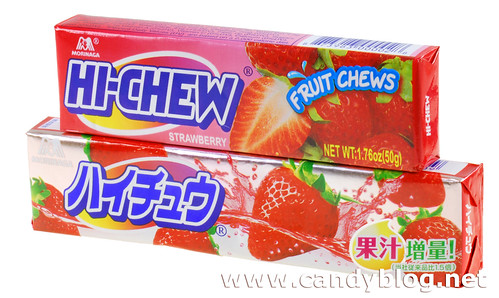
HiCHEW Japan vs HiCHEW Taiwan
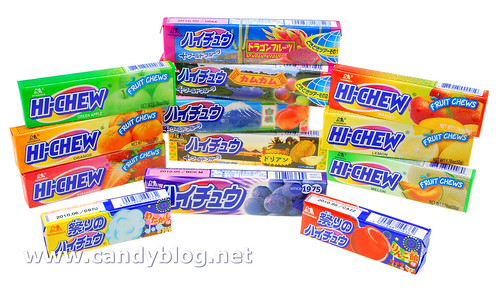
They’ve been popular in Japan for since 1975 (and existed in different formats for at least 40 years before that). Lately they’ve become more widely available in the United States and Canada, starting with large metropolitan areas with large Japanese populations. Now they’re pretty commonplace here in Los Angeles, I can get them at 7-11 or Target and the packaging has been Americanized with English wrapper and full nutrition facts. The American ones are made in Taiwan and feature slightly smaller packages at 1.76 ounces and sporting a price of about $1.00. The flavor set is rather ordinary with strawberry, orange, green apple, mango, lemon and melon (and sometimes banana) available. The Japanese also come in similar flavors with seasonal or limited edition varieties coming out all the time.
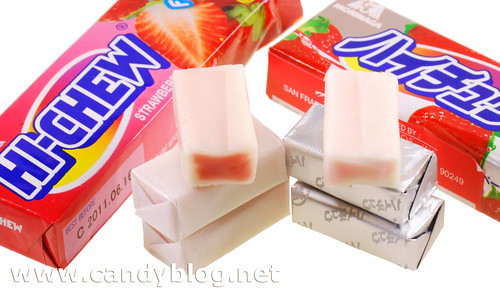
I decided to pick up a package of each and really put them to the test. Major differences:
The Taiwanese version is more intensely pink in the center. The chew is stiff at first, but still smooth. It’s slightly tangy and has a good strawberry flavor that errs more on the tart side than the floral sweetness though it does get a little jammy towards the end with cooked strawberry notes. The chew lasts a long time and never gets grainy. The Japanese version is a little softer and chewier. The flavor is also a well rounded berry with good sweet and sour notes, a little hint of floral and a creamy component (which might be attributed to a splash of yogurt in there). Instead of strawberry jam it was more like a strawberry smoothie.
Given a choice, I would pick up the Japanese version. Yes, I like to be able read my packages, but I also like my flavors bold and as authentic as they were originally conceived. I feel like the Taiwanese HiCHEW is like the Turkish Haribo Gummi Bear, not as good as those made in their homeland. However, I love the fact that this candy is able to get a wider audience. It’s a good introduction and perhaps die hard fans will work towards getting the real thing released in North America. Related Candies
Page 163 of 466 pages ‹ First < 161 162 163 164 165 > Last › 
|
Meticulously photographed and documented reviews of candy from around the world. And the occasional other sweet adventures. Open your mouth, expand your mind.
  SEARCHSearch the Candy Blog archives

    
FEATURED NEWS ITEMS
COPYRIGHT NOTICEAll content (text and photos unless otherwise credited) is copyright 2005-2026 by Cybele May Please do not use my photos without prior permission directly from me, they represent what I ate in preparation for these reviews and are not to be used for other purposes. Design by Hop Studios
|
||||||||||||||||||||||||||||||||||||||||||||||||


 SUPERB
 YUMMY
YUMMY  TASTY
TASTY  WORTH IT
  TEMPTING
  PLEASANT
  BENIGN
  UNAPPEALING
  APPALLING
  INEDIBLE